📰 Trending Topics
Google News - Trending
UNC trending for elite ACC transfer target - College Sports Wire
2026-04-13 18:25
Google News - Technology
Trendforce says hi-tech glue could be key to an invisible crease in the iPhone Ultra - 9to5Mac
2026-04-13 11:32
- Trendforce says hi-tech glue could be key to an invisible crease in the iPhone Ultra 9to5Mac
- Apple’s Foldable iPhone Remains on Track for September Debut (AAPL) Bloomberg.com
- Apple Is Launching an 'Ultra' Line of Products With New Capabilities — and Much Higher Price Tags entrepreneur.com
- Apple’s Entry into Foldable Smartphones Could Capture Approximately 20% Market Share; Stress Management Emerges as the Key to Reducing Creases, Says TrendForce TrendForce
- Smart Adhesive Is Key to Crease-Free Foldable iPhone Display MacRumors
iOS 26.5 beta 2 gives Apple Maps a new ads popup - 9to5Mac
2026-04-13 18:21
- iOS 26.5 beta 2 gives Apple Maps a new ads popup 9to5Mac
- Second macOS Tahoe 26.5 Beta Now Available for Developers MacRumors
- Everything new in the iOS 26.5 beta 1 update Sportskeeda Tech
- Testing of second iOS 26.5, macOS 26.5 developer beta builds now underway AppleInsider
- iPadOS 26.5 Beta 2 Arrives with Fixes and Minor Changes The Mac Observer
France is replacing 2.5 million Windows desktops with Linux - and I mapped out its new stack - ZDNET
2026-04-13 12:23
- France is replacing 2.5 million Windows desktops with Linux - and I mapped out its new stack ZDNET
- France says no to Microsoft Windows and the reason is America; says: We want to regain control of ... The Times of India
- France Kicks Windows to the Curb, Pivots to Linux OS PCMag
- French government says it's ditching Windows for Linux — country accelerates plans to ditch US-based software in digital sovereignty push Tom's Hardware
- France to ditch Windows for Linux to reduce reliance on US tech TechCrunch
Recent Galaxy Watch battery drain issue has one suspect and no clear answer - SamMobile
2026-04-13 10:39
- Recent Galaxy Watch battery drain issue has one suspect and no clear answer SamMobile
- Galaxy Watch users report abnormal battery drain after recent updates Android Authority
- Galaxy Watches have a troublemaker that's eating up all their battery Android Central
- Latest Galaxy Watch update could be a drain on battery, according to user reports 9to5Google
- Galaxy Watch Users Report Faster Battery Drain After Latest Update Android Headlines
Apple is making AI glasses, report claims - The Independent
2026-04-13 15:55
- Apple is making AI glasses, report claims The Independent
- Apple AI Glasses Will Rival Meta’s With Several Styles, Oval Cameras Bloomberg.com
- Apple is testing four smart glasses designs to compete with Meta, report says Mashable
- Apple’s New Wearables Push Will Start with Glasses In 2027, Report Says Gizmodo
- Apple's AI smart glasses strategy revealed: How the iPhone maker plans to outshine Meta's Ray-Bans Tom's Guide
NASA - Breaking News
NASA Announces 32nd Annual Human Exploration Rover Challenge Winners
2026-04-13 21:23
NASA’s 32nd annual Human Exploration Rover Challenge, one of the agency’s longest-standing student challenges, culminated April 10-11 with its final excursion event at the U.S. Space & Rocket Center near NASA’s Marshall Space Flight Center in Huntsville, Alabama.
Spanning nine months, the challenge tasks student teams from around the world to design, build, and test a lunar rover powered by either human pilots or remote control. The annual competition concluded with an awards ceremony recognizing the top-performing teams.
In the human-powered division, Parish Episcopal School in Dallas, Texas earned first place in the high school division, while the University of Central Missouri in Warrensburg, Missouri, won the college and university title. In the remote-control division, Gould Academy in Bethel, Maine, earned the top award in the middle and high school division, and The University of Alabama in Huntsville in Huntsville, Alabama, secured the college and university title.
More than 500 students representing 42 teams from around the world participated in the 32nd annual competition. Teams included students from 28 colleges and universities, 13 high schools, and one middle school across 18 U.S. states, Puerto Rico,
Teams were scored on their ability to navigate a half-mile obstacle course, complete mission-specific task challenges, and pass multiple safety and design reviews conducted by NASA engineers, with awards presented across human-powered and remote-control divisions.
“This challenge gives students a hands-on opportunity to think like engineers and problem-solvers, applying real-world design principles to complex exploration scenarios,” said Vemitra Alexander, who leads the Human Exploration Rover Challenge for NASA’s Office of STEM Engagement at Marshall. “By encouraging innovation and teamwork, we’re helping prepare the next generation to contribute to missions that will take us farther into space.”
Here is the full list of winners:
Human-Powered High School Division
- First Place: Parish Episcopal School, Dallas, Texas
- Second Place: Kealakehe High School, Kailua-Kona, Hawaii
- Third Place: Debbie Smith Career and Technical Education Academy, Reno, Nevada
Human-Powered College/University Division
- First Place: University of Central Missouri, Warrensburg, Missouri
- Second Place: Rhode Island School of Design, Providence, Rhode Island
- Third Place: The University of Alabama in Huntsville, Huntsville, Alabama
Remote-Control Middle School/High School Division
- First Place: Gould Academy, Bethel, Maine
- Second Place: SoulPhamm, South Plainfield, New Jersey
- Third Place: Space and Engineering Technologies Academy, San Antonio, Texas
Remote-Control College/University Division
- First Place: The University of Alabama in Huntsville, Huntsville, Alabama
- Second Place: South Dakota State University, Brookings, South Dakota
- Third Place: Florida Atlantic University, Boca Raton, Florida
Rookie of the Year
- Gould Academy, Bethel, Maine
Task Challenge Award
- Remote-Control
- Middle School/High School Division: Gould Academy, Bethel, Maine
- College/University Division: The University of Alabama in Huntsville, Huntsville, Alabama
- Human-Powered
- High School Division: Parish Episcopal School, Dallas, Texas
- College/University Division: Rhode Island School of Design, Providence, Rhode Island
Ingenuity Award
- Queen’s University, Kingston, Ontario, Canada
Phoenix Award
- Human-Powered
- High School Division: Parish Episcopal School, Dallas, Texas
- College/University Division: Rhode Island School of Design, Providence, Rhode Island
- Remote-Control
- Middle School/High School Division: Gould Academy, Bethel, Maine
- College/University Division: University of the District of Columbia, Washington, D.C.
Project Review Award
- Human-Powered
- High School Division: Parish Episcopal School, Dallas, Texas
- College/University Division: University of Central Missouri, Warrensburg, Missouri
- Remote-Control
- Middle School/High School Division: SoulPhamm, South Plainfield, New Jersey
- College/University Division: The University of Alabama in Huntsville, Huntsville, Alabama
Industry STEM Engagement Award
- Human-Powered
- High School Division: Erie High School, Erie, Colorado
- College/University Division: Instituto Tecnológico de Santo Domingo, Santo Domingo, Dominican Republic
- Remote-Control
- Middle School/High School Division: Gould Academy, Bethel, Maine
Community STEM Engagement Award
- Human-Powered
- High School Division: Debbie Smith Career and Technical Education Academy, Reno, Nevada
- College/University Division: Universidad Aeronáutica en Querétaro, Coyote, Mexico
- Remote-Control
- Middle School/High School Division: Chaminade High School, Mineola, New York
- College/University Division: ATLAS SkillTech University, Mumbai, India
Social Media Award
- Human-Powered
- High School Division: Albertville Innovation Academy, Albertville, Alabama
- College/University Division: Instituto Tecnológico de Santo Domingo, Santo Domingo, Dominican Republic
- Remote-Control
- Middle School/High School Division: Space and Engineering Technologies Academy, San Antonio, Texas
- College/University Division: ATLAS SkillTech University, Mumbai, India
Team Spirit Award
- Instituto Tecnológico de Santo Domingo, Santo Domingo, Dominican Republic
Crash and Burn Award
- The University of Alabama in Huntsville (Human Powered), Huntsville, Alabama
Most Improved Performance Award
- Human-Powered
- High School Division: Kealakehe High School, Kailua-Kona, Hawaii
- College/University Division: The University of Alabama in Huntsville, Huntsville, Alabama
- Remote-Control
- Middle School/High School Division: Gould Academy, Bethel, Maine
- College/University Division: Campbell University, Buies Creek, North Carolina
Safety Award
- High School Division: Parish Episcopal School, Dallas, Texas
- College/University Division: University of Central Missouri, Warrensburg, Missouri
Pit Crew Award
- High School Division: Erie High School, Erie, Colorado
- College/University Division: Campbell University, Buies Creek, North Carolina
Featherweight Award
- Campbell University, Buies Creek, North Carolina
The rover challenge is one of NASA’s eight Artemis Student Challenges reflecting the goals of the Artemis program, which will land Americans on the Moon while establishing a long-term presence for science and exploration, preparing for future human missions to Mars. NASA uses such challenges to encourage students to pursue degrees and careers in the fields of science, technology, engineering, and mathematics.
The competition is managed by NASA’s Office of STEM Engagement at NASA Marshall. Since its inception in 1994, more than 15,000 students have participated – with many former students working at NASA, or within the aerospace industry.
Learn more about the Human Exploration Rover Challenge.
Share
Details
Related Terms
NASA Awards Data Engineering, Informatics Support Contract
2026-04-13 20:58

NASA has selected Development Seed of Washington to provide research and development services to the Office of Data Science and Informatics (ODSI) at the agency’s Marshall Space Flight Center in Huntsville, Alabama.
The award is a performance-based, indefinite-delivery/indefinite-quantity contract with a maximum potential value of $76 million. A phase-in period begins on May 15, 2026, followed by a two-year base ordering period, with three one-year options to extend services through June 2031.
Under the contract, Development Seed will provide scientific research and development support services for ODSI projects, including system architecture expertise, operations and maintenance of ODSI-developed tools and platforms, and systematic approaches to data curation, management, and stewardship. The contractor also will provide subject matter expertise in informatics, data science, and information management, as well as develop and deploy artificial intelligence and machine learning solutions to advance science data systems.
For information about NASA and agency programs, visit:
-end-
Jennifer Dooren / Jessica Taveau
Headquarters, Washington
202-358-1600
jennifer.m.dooren@nasa.gov / jessica.c.taveau@nasa.gov
Molly Porter
Marshall Space Flight Center, Huntsville, Ala.
256-424-5158
molly.a.porter@nasa.gov
Curiosity Blog, Sols 4852–4858: When Data Take Their Time…
2026-04-13 20:04
4 min read
Curiosity Blog, Sols 4852–4858: When Data Take Their Time…
Written by Susanne P. Schwenzer, Professor of Planetary Mineralogy at The Open University, UK
Earth planning date: Friday, April 3, 2026
I was the geology science team lead on Monday for planning Sols 4852-4853, when our data did not arrive on time for planning. Thus, we got creative as a team thinking what we could do, not knowing where exactly our rover might be. And for that we first thought about AEGIS, the capability of the rover to find a target for ChemCam LIBS measurements on its own.
We normally use this capability after drives, before we have seen the data here on Earth, to get an extra LIBS measurement. This time, we put two of those observations into the plan, and added many atmospheric and environmental observations, such as dust-devil movies, too. It’s an interesting planning session that always makes the team talk more than normal, because there are no routines for those days! I find it both tense and rewarding at the same time. Anything that isn’t quite as expected adds levels of complexity that require more focus and more thinking, hence making me tense. But it is also really nice when we’ve succeeded in making the best of those days. My colleagues also seem to have lots of energy and are especially supportive of each other. That said, like everyone else I prefer the routine days where everything goes right and we focus on the science.
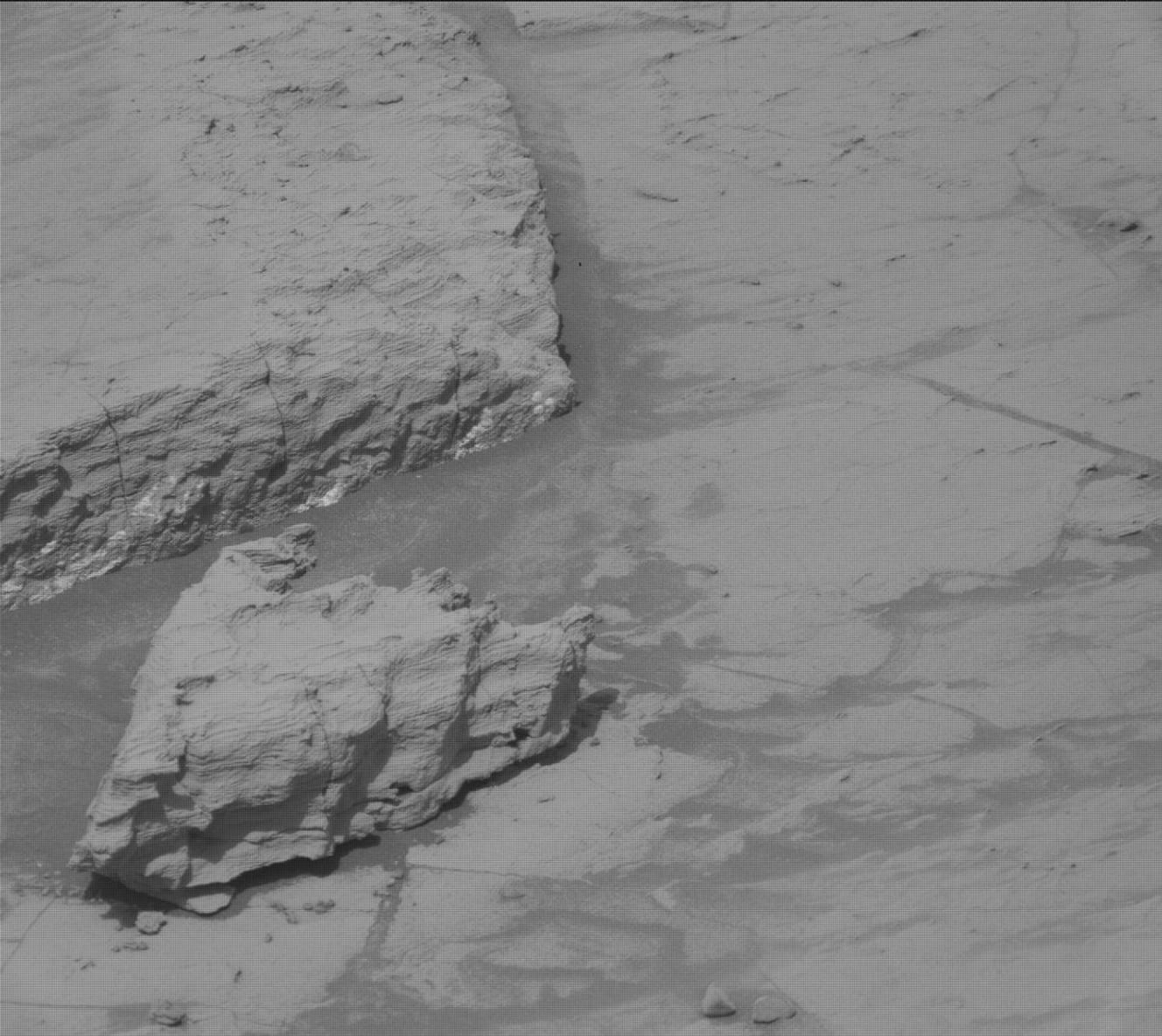
All our data arrived perfectly fine in time for planning on Wednesday and we found ourselves in a terrain with many blocks that have polygons on their top surface. Do check out the images, it’s a wild terrain that reminded me of some boulder-rich terrains we have seen back on the margins of the Gediz Vallis Channel. It is interesting to see the distribution of the blocks, and I am curious how they might change along the traverse up Mount Sharp. For now, we have an activity that we call “MARDI sidewalk” in the plan. This means the MARDI camera takes images while the rover is driving, on Sol 4855. Those image sequences give great insights into changing terrains, and we are looking forward to the data reaching us!
Over the course of the week, ChemCam did three AEGIS observations and four human-pointed observations on the targets “Las Petas,” “Punta Negra,” “Pampa del Molle,” and “Los Condores.” We were trying to measure the normal-looking bedrock and all the different features, some of which you can see in the image above. We want to find out what the higher-standing materials are that form those prominent polygons. APXS is getting four targets in the plan, also looking at the diversity of rocks. These are called “Rio Espiritu Santo,” “La Escalera,” “Los Condores,” and “Tropico de Capricornio.” It’s all focused on understanding what forms the polygons, because any differences in chemistry could tell us a lot about what happened and how the polygons came to be. By extension, this will then allow the team to deduce the environmental conditions at the time the polygons formed.
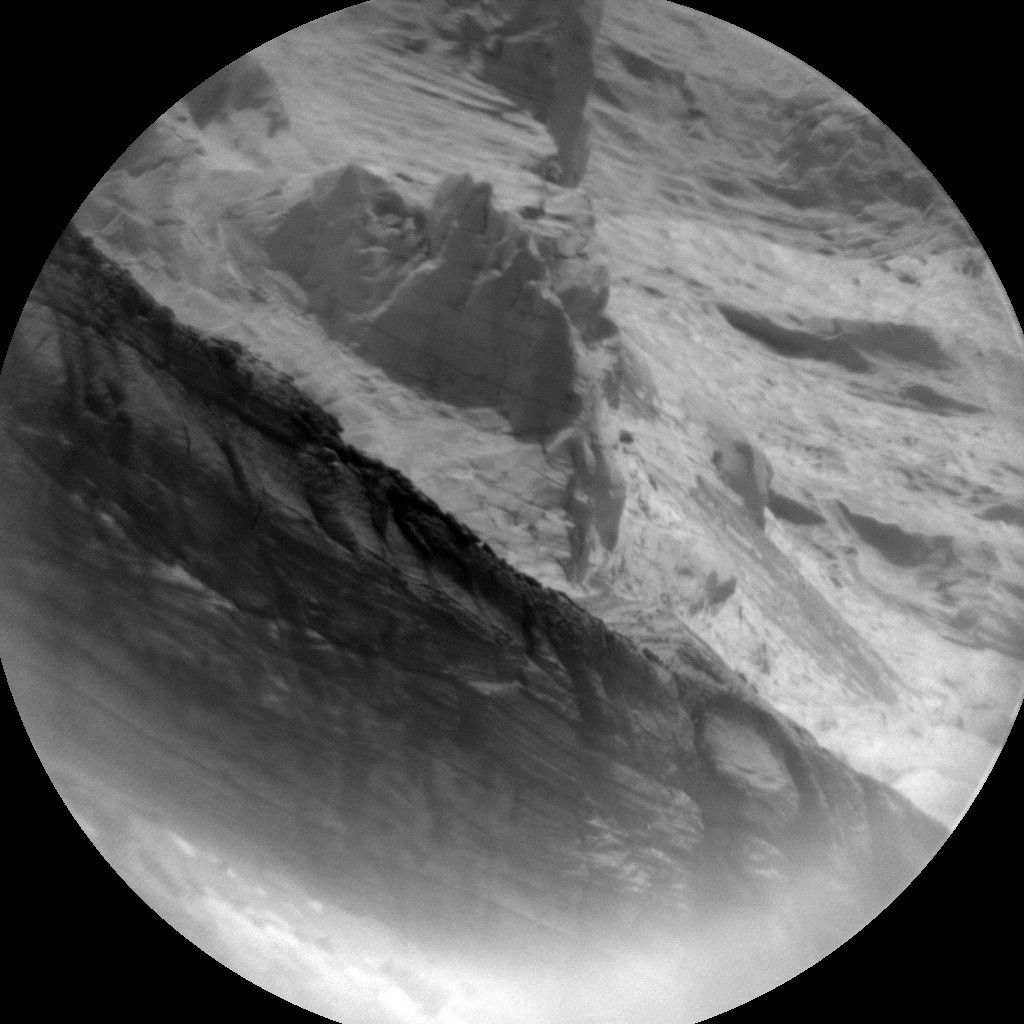
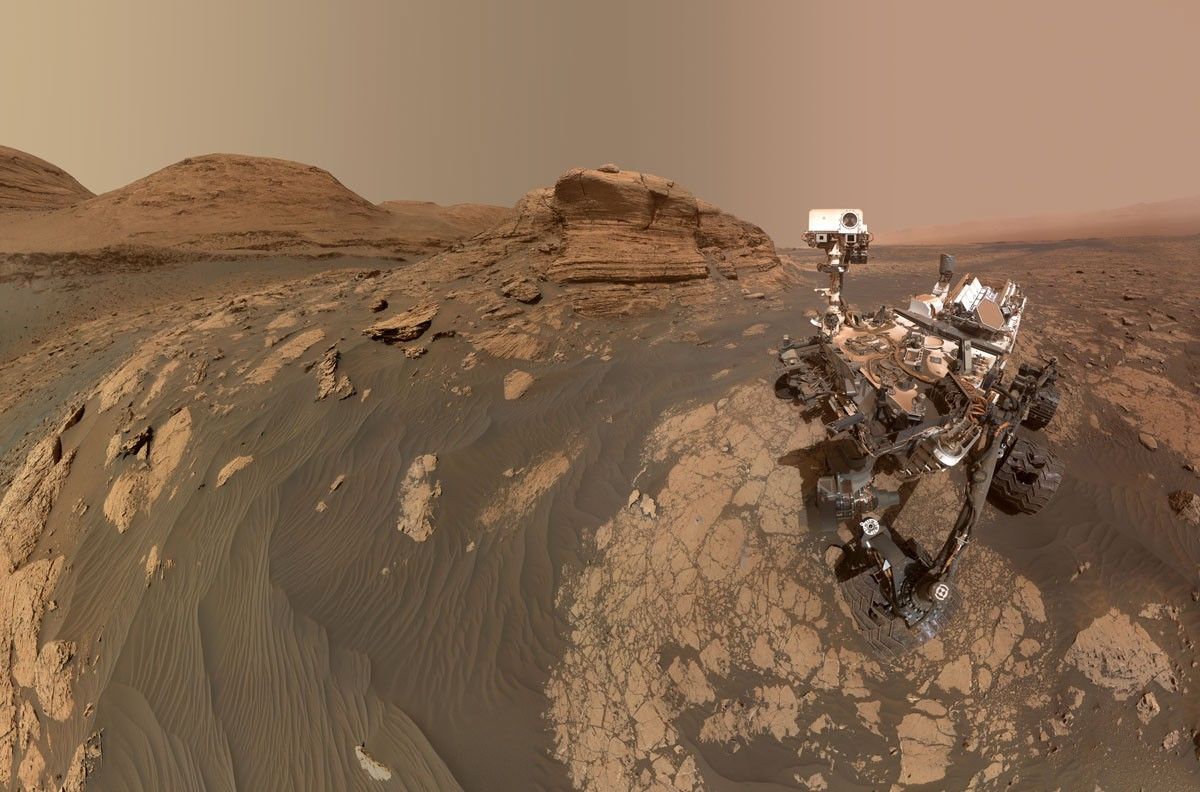
As you may guess, imaging is very important in a landscape as varied as this! Mastcam is looking in many directions in the near-field and further up the road — our projected drive path. In addition, ChemCam is taking long-distance images with its Remote Micro Imager (RMI) to get a closer look at the walls around us. The butte called “Mishe Mokwa” is still one of the RMI and Mastcam favorites because it gives us many insights into its structure as we are driving past and also somewhat around it.
Atmospheric and environmental observations occur all across the plans and include atmospheric opacity measurements, dust-devil searches and, in Friday’s plan, also an APXS atmospheric measurement. The DAN instrument is monitoring water in the subsurface across all plans. So, it’s three full plans, despite the little extra wait on the data!
And while I am writing this, four astronauts in the Orion capsule are on the way around the Moon. I am very excited! When Apollo 8 was the very first mission to ever fly around the Moon in December 1968, I wasn’t born yet. In fact, I arrived a few months after Apollo 11 had landed on the Moon for the first time. Now being able to witness these lunar missions myself, to hear the voices between the Integrity spacecraft and the control room in Houston, and to see the pictures as they arrive … magnificent! Go, Artemis II!
Share
Details
Related Terms
Explore More


Curiosity Blog, Sols 4845-4851: Bye-Bye Boxwork, Bye-Bye
2026-04-13 19:37
3 min read
Curiosity Blog, Sols 4845-4851: Bye-Bye Boxwork, Bye-Bye
Written by Lucy Thompson, APXS Strategic Planner and Planetary Geologist at the University of New Brunswick, Canada
Earth planning date: Friday, March 27, 2026
Last weekend’s drive took us just over the southernmost contact of the boxwork terrain with the surrounding layered sulfate unit. This was our third time crossing this contact, providing an excellent opportunity to look for any changes across it. We have acquired multiple observations (chemistry and imaging for textures) of the boxwork-bearing bedrock close to the contact. We are also interested in determining whether the layered sulfate unit to the south of the boxwork terrain has the same depositional setting as that encountered to the north. Is the composition the same as the typical layered sulfate unit we encountered prior to the boxwork, or could there be a change associated with a different depositional environment, source sediment, or potential alteration along the contact with the boxwork?
Unfortunately, although the weekend drive was successful, Curiosity was not on stable enough ground coming into planning Monday to brush the dusty bedrock, although we were able to get MAHLI imaging of a block within the workspace. The rover engineers repositioned the rover so that we could safely unstow the arm, brush, image with MAHLI, and analyze with APXS the layered sulfate unit bedrock just across the contact (“Santa Rosa”) in Wednesday’s plan. We also looked at a concentration of granules with APXS and MAHLI (“Piedra Colgada”). They appear to be a collection of fine nodules that eroded from the bedrock, thereby allowing us to obtain chemical and textural data on these nodules.
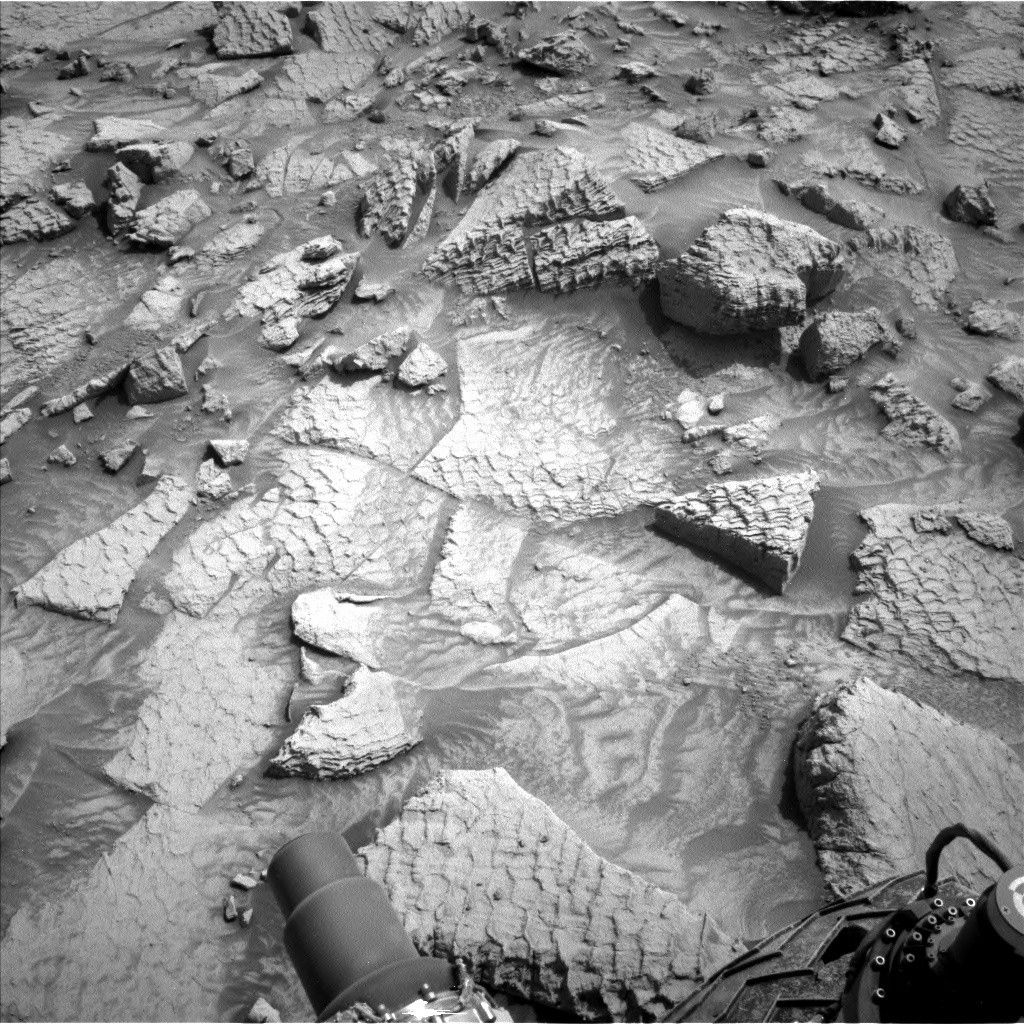
The drive planned on Wednesday took us another 50 meters (about 164 feet) away from the boxwork, to a stunning sulfate unit workspace. The bedrock contained abundant resistant ridges forming a polygonal pattern. We wanted to compare these current exposures with polygonal textures observed previously, for example, within the boxwork, the sulfate unit before the boxwork, and the clay-sulfate transition. We are brushing two spots on the bedrock in front of us (“Ocharaza” and “Nevado Tres Cruces”) and analyzing them both with APXS and MAHLI for chemistry and texture.
Across the three plans, Mastcam imaging was acquired of the boxwork terrain behind, the sulfate unit ahead, and the rocks immediately in front of us. In particular, this weekend’s plan was jam-packed full of mosaics to capture the amazing polygonal textures surrounding the rover. The planned 30-meter drive (about 98 feet) should keep us in this same terrain.
The environmental group has also been busy planning multiple observations to monitor atmospheric opacity, optical depth and aerosol scattering properties, clouds, wind direction, and potential dust-devil activity. Navcam and Mastcam are utilized to make these observations. As usual, our plans this week included the standard DAN, REMS and RAD activities.
Share
Details
Related Terms
Explore More
NASA to Host Artemis II Crew Postflight News Conference
2026-04-13 18:16
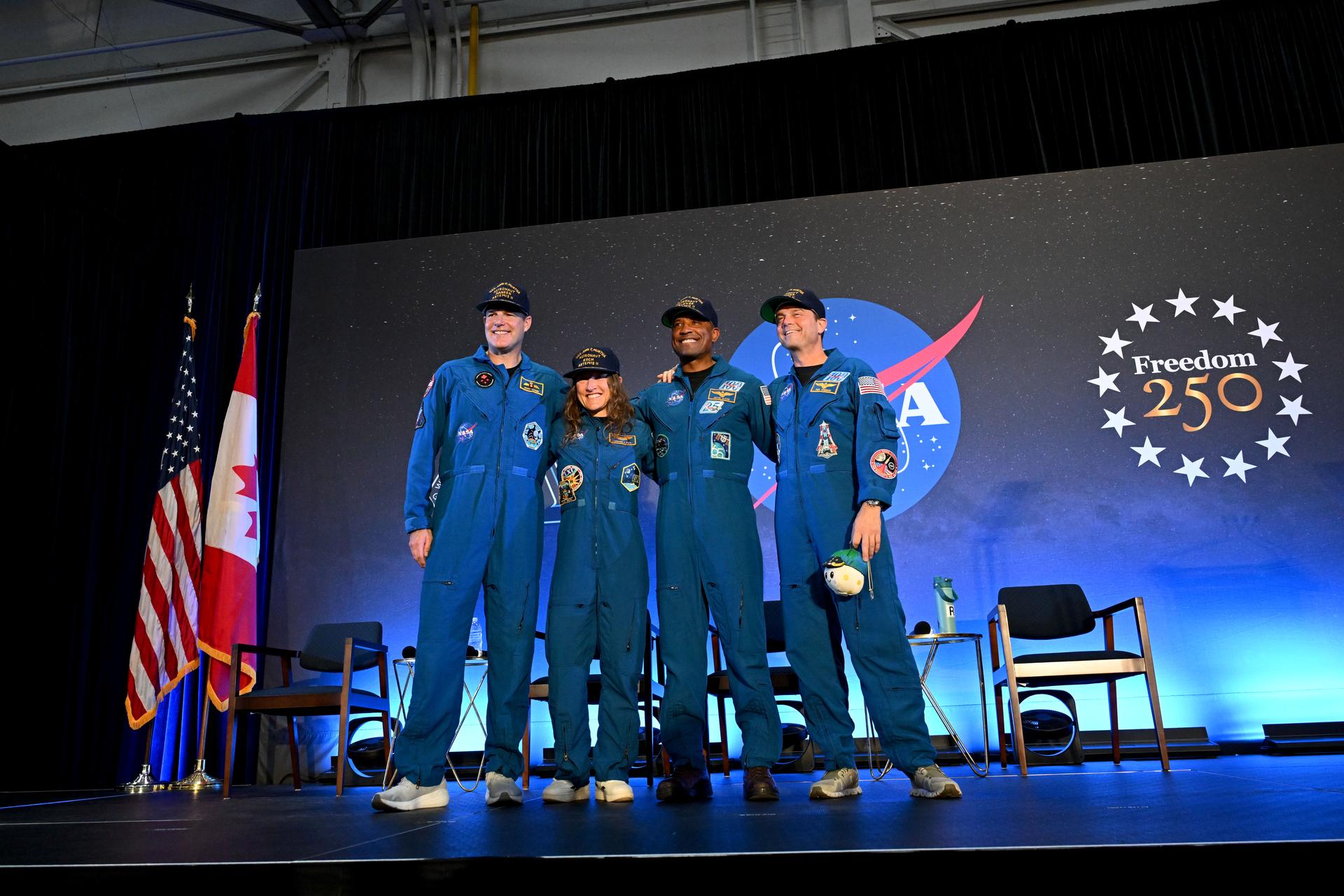
Fresh off their return to Earth, the Artemis II astronauts will hold a news conference at 2:30 p.m. EDT Thursday, April 16, at NASA’s Johnson Space Center in Houston to discuss their historic mission around the Moon.
NASA astronauts Reid Wiseman, Victor Glover, and Christina Koch, along with CSA (Canadian Space Agency) astronaut Jeremy Hansen, will answer questions about their mission. The crew returned to Earth on April 10, splashing down off the coast of San Diego, and arrived in Houston on April 11, where they are undergoing standard postflight reconditioning, evaluations, and lunar science debriefs.
NASA will provide live coverage of the news conference on the agency’s YouTube channel. Learn how to watch NASA content through a variety of additional online platforms, including social media.
Media are invited to attend in person or by phone.
In-person attendance is limited to media previously credentialed by NASA Johnson for the Artemis II mission. To attend in person, contact the NASA Johnson newsroom by 5 p.m. CDT Tuesday, April 14, at jsccommu@mail.nasa.gov.
Media joining by phone must RSVP to the NASA Johnson newsroom via email by 5 p.m. CDT Wednesday, April 15. Those participating by phone must dial in no later than 10 minutes before the start of the event.
NASA’s media accreditation policy is available on the agency’s website.
The Artemis II mission launched April 1 on NASA’s SLS (Space Launch System) rocket from the agency’s Kennedy Space Center in Florida. During the nearly 10‑day test flight, the crew achieved the mission’s primary objectives, including testing its life support systems; manually piloting the Orion spacecraft; performing maneuvers to propel Orion to the Moon and adjust its course; conducting a lunar flyby with unprecedented views of the Moon’s far side; and completing a safe re-entry and recovery. The astronauts also set a record for the farthest distance traveled by humans away from Earth.
As part of a Golden Age of innovation and exploration, NASA will send Artemis astronauts on increasingly challenging missions to explore more of the Moon for scientific discovery, economic benefits, establish an enduring human presence on the lunar surface, and lay the groundwork for sending the first astronauts – American astronauts – to Mars.
Learn more about the mission by visiting:
https://www.nasa.gov/artemis-ii
-end-
Rachel Kraft / Lauren Low
Headquarters, Washington
202-358-1600
rachel.h.kraft@nasa.gov / lauren.e.low@nasa.gov
Courtney Beasley
Johnson Space Center, Houston
281-483-5111
courtney.m.beasley@nasa.gov
TechCrunch - Latest
Uber and Nuro begin testing premium robotaxi service in San Francisco
2026-04-13 21:11
Microsoft is officially killing its Outlook Lite app next month
2026-04-13 20:59
Thousands of rare concert recordings are landing on the Internet Archive — listen now
2026-04-13 20:20
IBM pays $17M fine to end DOJ suit over DEI programs
2026-04-13 19:11
Microsoft is working on yet another OpenClaw-like agent
2026-04-13 19:05


